
Overview
Relational and graph, in one database.
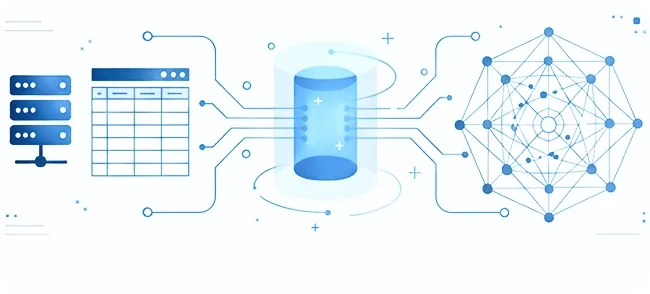
Relational databases run almost every business application.
Graph databases turn connected data (customers and what they buy, transactions and the accounts behind them, drugs and their side effects) into answers that are hard to get from tables alone.
Most teams that need both end up running two products and building pipelines to keep them in sync.
CoraDB removes that split: it is one native database with the full capabilities of both, so relational data such as customers, accounts and products can live next to the graph used for fraud detection, recommendations or knowledge bases, with no migration, synchronization or duplication.
Key highlights
Unified storage
Graph data and the relational data around it are stored in the same place, managed by one engine.
One connection, one query
Your application uses one connection for everything, and a single statement can combine SQL with PGQL graph patterns.
Simpler architecture
No second database, no ETL between them, no copies to keep in sync, and one system to secure, back up and monitor.
Native performance
Relational and graph processing are implemented in the same C/C++ core, with no add-ons or external libraries. See the benchmarks.
Industry standards
Full SQL compatibility and PGQL for graphs, with drivers for Java, .NET, Python, PHP and Node.js.
Primary database unaltered
Adding graph capabilities does not alter your primary source database.
Use it your way
There are no limits on how you use CoraDB.
Relational + graph
Tables, vertices and edges side by side, queried together.
The main reason CoraDB exists.
Relational only
A fast, standard SQL database, without using the graph features.
Graph only
A dedicated graph database, with vertex and edge tables and PGQL queries.
Documents too
A JSON data type gives out-of-the-box NoSQL capabilities next to both.
Performance
Up to 3× faster than Neo4j.
In CoraDB’s LDBC SNB and FinBench benchmark testing, CoraDB ran up to three times faster than Neo4j under the tested configurations, while delivering relational performance comparable to MySQL on the tested workloads.
A complete ecosystem
Built-in apps with AI assistants (Magos, WebSQL, Graph Viewer, WebAdmin, Relational-to-Graph), MCP servers for AI tools, five drivers and ten demo databases.
Available on-premises and in the cloud.
See it for yourself
Create a database, build a small graph and run your first SQL + graph query.
Want the details first?
Read how CoraDB works.